


Archives
-
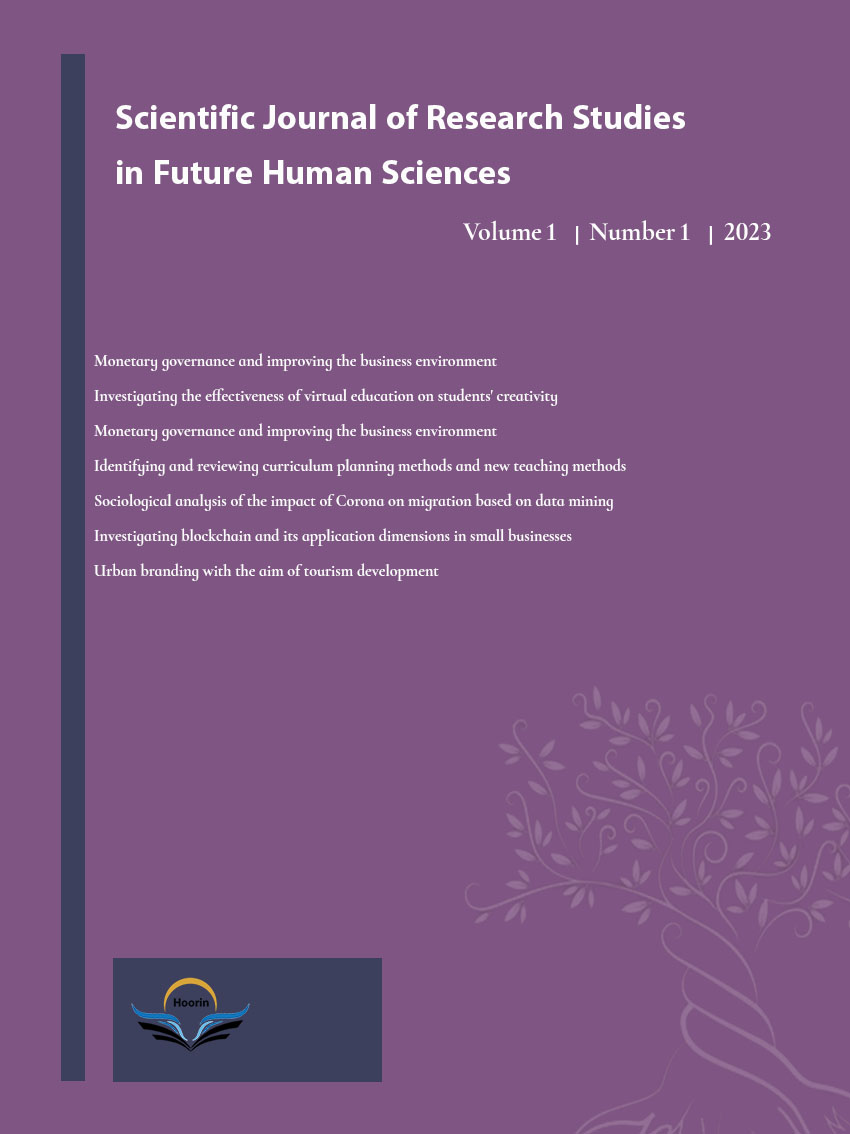
Vol. 1 No. 1 (2023)
This issue presents interdisciplinary research addressing macroeconomic dynamics, educational innovation, international trade, data-driven sociological analysis, blockchain technology, and urban branding strategies. The published studies analyze the determinants of exchange rate fluctuations and misalignment in Iran’s economy and identify key factors influencing international trade success among small businesses.
In the field of education, the effectiveness of virtual learning in enhancing student creativity is examined alongside contemporary curriculum planning and innovative teaching methodologies. The sociological impact of the COVID-19 pandemic on migration patterns is also assessed using data mining techniques.
Additional contributions explore the dimensions and applications of blockchain technology in small enterprises to improve transparency and operational efficiency, and analyze urban branding as a strategic tool for tourism development and city competitiveness.
All contributions have undergone a rigorous peer-review process and aim to provide analytical and evidence-based insights for strengthening economic policy, educational reform, entrepreneurial development, and sustainable urban growth.
-

Vol. 3 No. 1 (2025)
This issue presents interdisciplinary research spanning Islamic philosophy and mysticism, theology, comparative law, civil liability, digital banking regulation, international relations, and behavioral management studies. The published studies examine the narrative foundations of graded infallibility (ʿisma tashkiki) through a philosophical-mystical approach and analyze the relationship between human agency and freedom in Islam with reference to the views of Shahid Deylami. The influence of political dynamics within early Islamic caliphates on historiographical orientations in early historical texts is also critically assessed.
The issue further explores the quantification of state civil liability for failure in public service delivery based on administrative performance indicators, and evaluates the legal responsibility arising from digital banking errors in electronic payment systems using empirical transaction disruption data. Additional contributions assess the effectiveness of criminal law mechanisms in controlling commission-taking in transnational commercial transactions within Iranian and French legal frameworks, and provide a comparative analysis of fault, statutory interest rates, and timing of claims in the realization of delay damages across Iranian, French, and English legal systems.
Moreover, the role of diplomatic protocol in enhancing international relations, the moderating role of marketing intelligence in the relationship between neuromarketing and brand preference, and the impact of emotional intelligence on classroom management and student engagement are addressed.
All contributions have undergone a rigorous peer-review process and aim to advance theoretical discourse and practical frameworks across theology, legal studies, public governance, and behavioral management research.
-

Vol. 2 No. 1 (2024)
This issue presents interdisciplinary research addressing social, political, technological, educational, legal, and health-related domains. The published studies analyze social determinants influencing investment decisions in emerging cryptocurrencies through grounded theory methodology and evaluate barriers to blockchain adoption in information management and library systems.
In the field of education and linguistics, the causes of elementary students’ difficulties in memorizing and reciting Persian poetry are examined, alongside an analysis of core vocabulary in primary school textbooks based on linguistic references. The role of extracurricular educational activities in fostering student creativity and talent development, as well as a bidirectional investigation of language production and comprehension as either separate or integrated cognitive processes, are also explored.
From a political and international relations perspective, the issue investigates the role of the military in Egyptian governance during and after Hosni Mubarak, cultural transformation and political participation in Iranian civil society, and the involvement of NATO and Eastern European actors—focusing on the Czech Republic and Poland—in Middle Eastern dynamics.
Additional contributions examine the jurisprudential and legal nature of time-scheduled transfer of ownership in Iranian law and assess seasonal variations in vitamin D levels among female athletes.
All contributions have undergone a rigorous peer-review process and aim to advance interdisciplinary scholarship, evidence-based policymaking, and theoretical development across the social sciences and emerging technologies.