


Archives
-

Vol. 3 No. 1 (2025)
This issue presents scholarly contributions addressing contemporary developments in public law, administrative law, criminal law, civil liability, and commercial dispute resolution, with particular emphasis on emerging technological and governance challenges. The published studies examine the civil liability of oil companies for environmental damages and behavioral patterns in medical liability with predictive implications for patient safety outcomes. The interpretative role of the Administrative Justice Court in shaping Iranian administrative law and the principle of transparency in administrative interpretation and enforcement are also critically analyzed.
The issue further explores cybercrimes with a victim-centered approach focusing on women as vulnerable victims, and offers a comparative analysis of Iran and England regarding preventive legal and institutional frameworks for emerging cyber offenses. Money laundering in the sports industry and the challenges posed by emerging technologies such as deepfake in sports contracts are assessed from a criminal law and prevention perspective.
Additional contributions address the role of local policing in enhancing social capital and reducing urban crime, ownership structures in digital asset management and emerging data-based property regimes, efficiency indicators in online commercial arbitration and cross-border enforcement success, the identification of commercial character in immovable property transactions in Iranian and French judicial practice, and the doctrinal challenges in distinguishing bribery from unlawful influence in Iranian criminal law.
All contributions have undergone a rigorous peer-review process and aim to provide analytical and policy-relevant frameworks for strengthening administrative justice, institutional transparency, citizen protection, and legal adaptability in the face of technological transformation.
-

Vol. 2 No. 1 (2024)
This issue presents scholarly contributions in Islamic jurisprudence, comparative law, judicial interpretation, human dignity, and victim protection. The published studies examine the legal status of women in Islam and pre-Islamic religions, offering comparative analyses with legal systems in Iran, England, and Europe. The issue also evaluates the interpretive and juristic perspectives of Sayyed Kamal Heidari regarding the position of women in Islam, in comparison with the exegetical views of Allama Tabataba’i.
Further contributions analyze the scope of judicial interpretation in Iranian law through a comparative study with English and French legal systems, and explore the jurisprudential ruling of prostration from both Shi’a and Sunni perspectives, with particular emphasis on the Imamiyya view. Additional research addresses the legal consequences of seizing undocumented immovable property under Iranian law and the concept of constructive loss (legal destruction) in Iranian judicial practice.
The issue also investigates the jurisprudential and legal dimensions of human dignity within the framework of Islamic philosophy and provides a comparative study of victim protection mechanisms in cybercrime legislation in India, Canada, and Australia. All contributions have undergone a rigorous peer-review process and aim to advance doctrinal analysis and comparative scholarship in Islamic and public law.
-
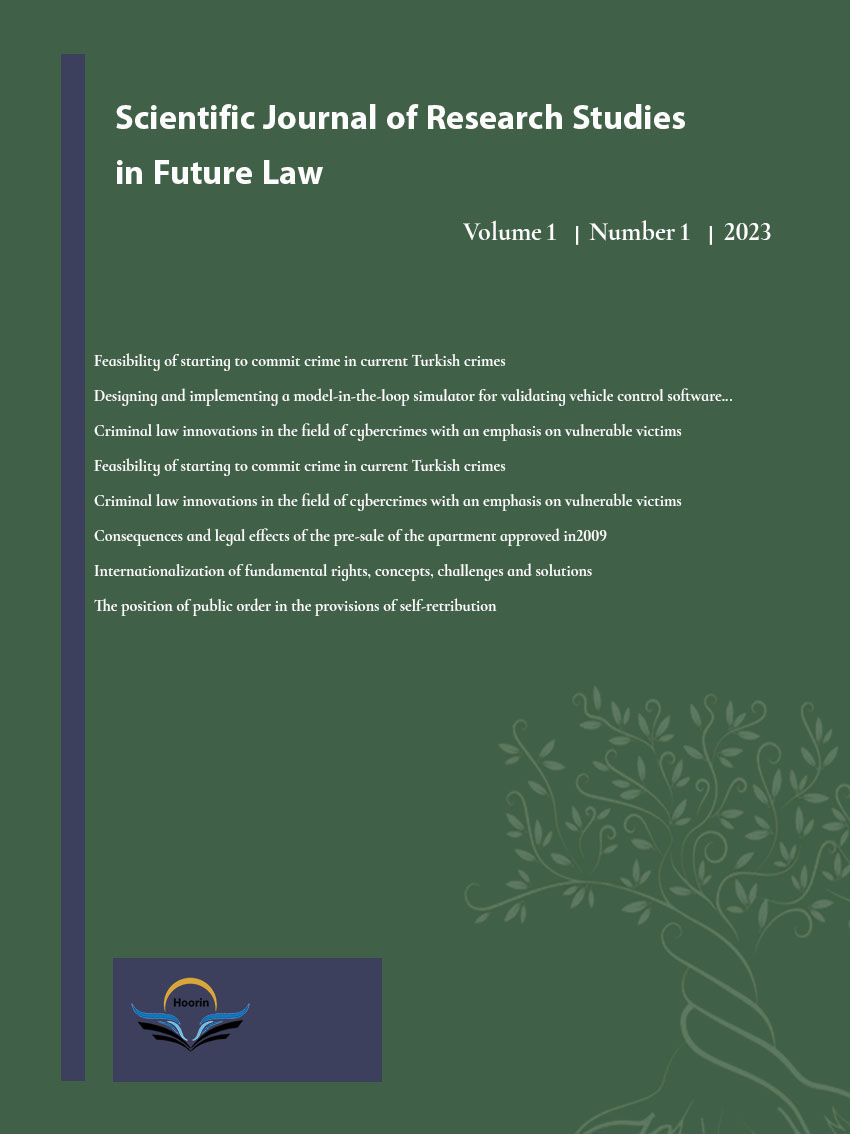
Vol. 1 No. 1 (2023)
This issue presents scholarly contributions in criminal law, public law, civil law, and constitutional studies through analytical and comparative approaches. The published research examines the feasibility of establishing criminal attempt in omission-based offenses, the legal conditions governing compulsory acquisition of endowments (waqf properties), and diverse models of crime prevention in Iranian and international legal systems, with particular emphasis on the liberal crime control model.
The issue further analyzes the legal consequences of the 2009 Pre-Sale of Apartments Act, explores the challenges and prospects of the internationalization of constitutional law, and evaluates the role of public order in regulations governing retributive punishment (qisas) within the Iranian legal framework.
All contributions have undergone a rigorous peer-review process and aim to strengthen both doctrinal foundations and practical applications in legislation, legal interpretation, and judicial practice.