


Archives
-
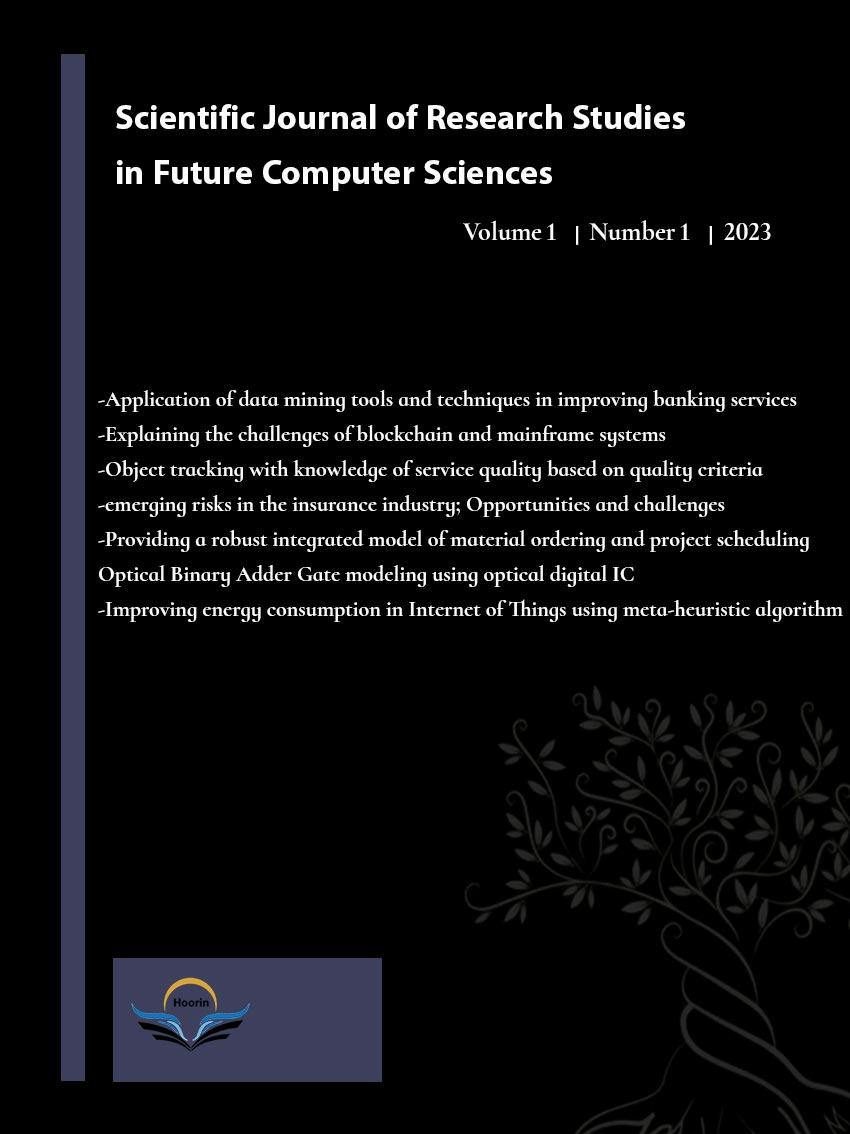
Vol. 1 No. 1 (2023)
This issue presents scholarly contributions in computer engineering, intelligent systems, digital risk management, and optimization technologies. The published studies explore the application of data mining tools and techniques to enhance banking services and analyze the challenges of integrating blockchain technologies with legacy mainframe systems.
The issue further examines object tracking in wireless sensor networks with Quality of Service (QoS) awareness based on defined performance metrics. Emerging risks in the insurance industry—particularly cyber risks—are critically assessed in terms of both opportunities and structural challenges.
Additional contributions propose a robust integrated model for material ordering and project scheduling under resource constraints and uncertainty, present optical binary adder gate modeling using digital optical integrated circuits, and investigate energy optimization in Internet of Things (IoT) environments through metaheuristic algorithms.
All contributions have undergone a rigorous peer-review process and aim to provide technically grounded and innovation-driven solutions for enhancing efficiency, security, and optimization in complex data-intensive systems.
-

Vol. 2 No. 1 (2024)
This issue presents scholarly contributions in artificial intelligence, machine learning, computer vision, cybersecurity, cloud computing, and organizational data analytics. The published studies explore enhanced human identification through the fusion of gait and facial features, and propose a novel semantic-based image retrieval method.
The issue further examines an ontology-driven neuro-symbolic defense framework against adversarial attacks in IoT-based cyber-physical systems, validated through experimental implementation within a smart campus infrastructure. Additionally, the efficiency of cost prediction algorithms in cloud computing environments is analyzed, proposing a hybrid model for organizational budget optimization.
Other contributions address the identification of high-value banking customers using social network analysis techniques and the real-world evaluation of an AI-based predictive decision support system aimed at improving performance in small and medium-sized enterprises. The impact of gamification on student engagement and learning motivation is also investigated within an educational context.
All contributions have undergone a rigorous peer-review process and aim to provide data-driven, technology-oriented, and problem-focused insights to enhance security, operational efficiency, and intelligent decision-making in digital infrastructures and organizations.