


Archives
-
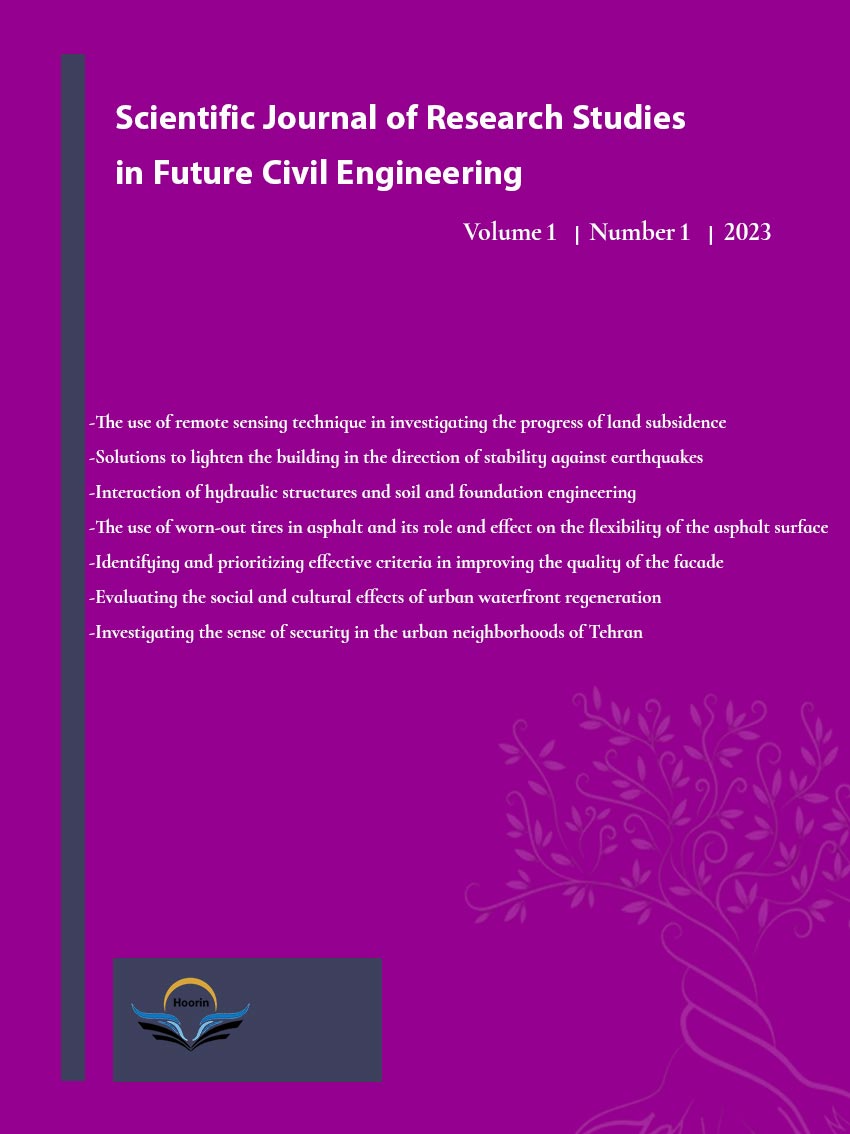
Vol. 1 No. 1 (2023)
This issue presents scholarly contributions addressing technical, environmental, and socio-urban dimensions of infrastructure and urban development through analytical and applied perspectives. The published studies examine the application of remote sensing techniques in monitoring and assessing land subsidence progression, and analyze lightweight construction strategies aimed at enhancing seismic resilience.
The issue further explores the interaction between hydraulic structures and geotechnical engineering systems, and evaluates the incorporation of waste crumb rubber in asphalt mixtures and its impact on pavement flexibility and performance. Additionally, key criteria influencing façade quality improvement are identified and prioritized using the Analytic Hierarchy Process (AHP) model.
Further contributions assess the social and cultural impacts of urban waterfront regeneration projects and investigate the perception of safety in Tehran’s urban neighborhoods, with a focused case study of Sadeghieh district.
All contributions have undergone a rigorous peer-review process and aim to advance structural safety, sustainable infrastructure development, urban environmental quality, and socio-spatial well-being through interdisciplinary research.
-

Vol. 3 No. 1 (2025)
This issue presents advanced research in structural engineering, civil infrastructure management, urban megaproject governance, environmental liability, transportation systems, and water resource resilience. The published studies investigate the optimal distribution of viscoelastic dampers in steel moment-resisting frames using a generalized frequency-dependent damping model, and provide numerical evaluation of yield-line mechanisms in steel–concrete composite slabs considering realistic nonlinear material behavior.
The issue further proposes a performance-based legal and managerial framework for reducing delay claims in urban construction megaprojects and analyzes civil liability patterns arising from environmental damages in infrastructure development due to non-compliance with regulatory requirements.
Additional contributions assess multi-state passenger flow dynamics in urban metro networks using real-time operational data, and present scenario-based modeling of water resource resilience through coupled hydrological forecasting systems and demand pattern analysis in Tehran and adjacent arid regions. The structural performance and fatigue life of environmentally compatible two-layer concrete pavements incorporating recycled asphalt aggregates are also examined.
All contributions have undergone a rigorous peer-review process and aim to advance structural safety, infrastructure resilience, risk-informed project governance, and sustainable resource management through technically robust and application-oriented research.
-

Vol. 2 No. 1 (2024)
This issue presents advanced research in geotechnical engineering, structural optimization, construction management, contemporary architecture, sustainable materials, and digital transformation in infrastructure systems. The published studies estimate the bearing capacity of driven piles in sandy-clay soils using radial basis function neural networks and multilayer perceptrons, and examine the role of artificial intelligence in the economic optimization of steel structural design.
The issue further explores construction management optimization through modern sustainable and lightweight construction methods, and analyzes postmodern design principles in the development of recreational and tourism complexes. The impact of groundwater exploitation on crustal stress variations and increased seismic activity in Iranian plains is also assessed.
Additional contributions investigate the influence of sustainable materials and modern construction techniques on residential energy efficiency, evaluate the effectiveness of an integrated Digital Twin and AI framework for real-time cost and schedule optimization in civil projects, and provide a comparative assessment of stone columns and cement grouting techniques on shear strength improvement and settlement reduction in saturated clay soils using numerical modeling and field data.
All contributions have undergone a rigorous peer-review process and aim to advance geotechnical safety, energy-efficient design, intelligent project management, and sustainable infrastructure development through technically robust and data-driven methodologies.