


Archives
-
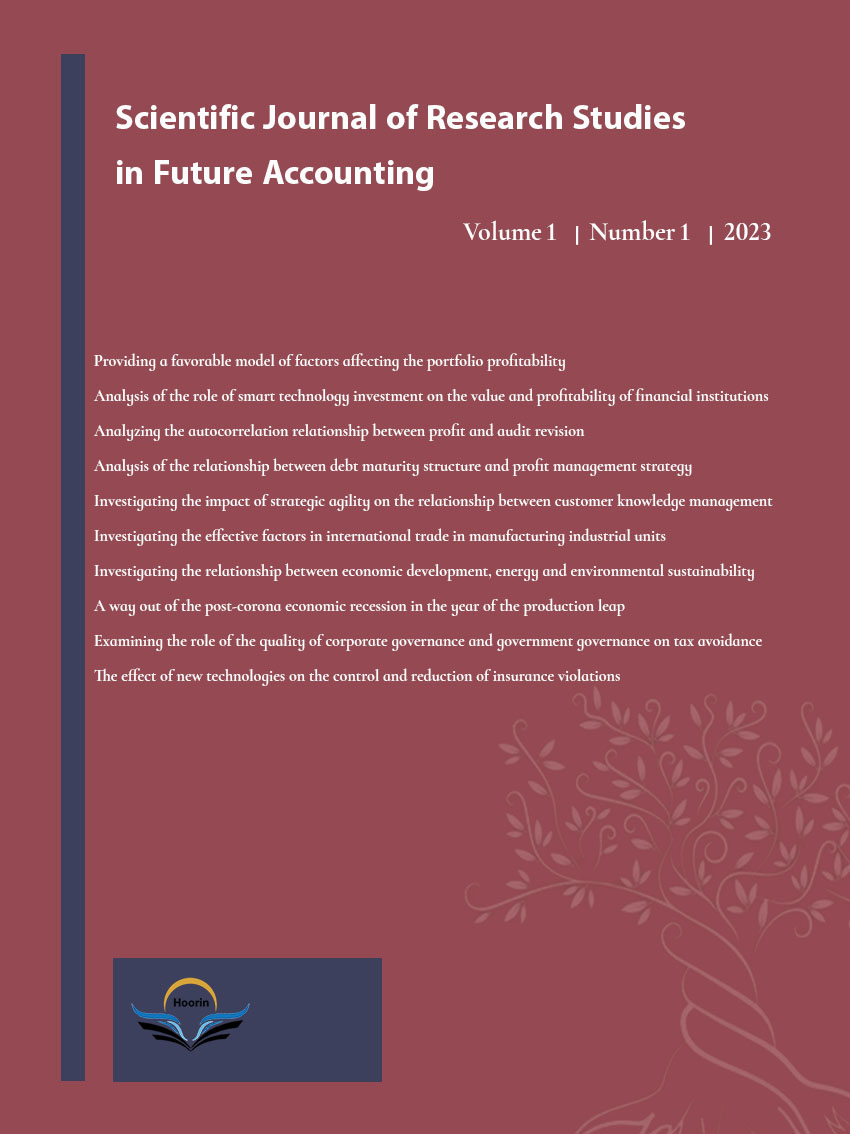
Vol. 1 No. 1 (2023)
This issue presents scholarly contributions in financial management, capital markets, corporate governance, macroeconomic development, and emerging technologies within industrial and financial systems. The published studies propose a conceptual model of determinants influencing stock portfolio profitability and analyze the role of smart technology investment in enhancing the value and profitability of financial institutions.
The issue further examines the relationship between earnings autocorrelation and audit revisions, as well as the linkage between debt maturity structure and earnings management strategies. Strategic agility in strengthening the relationship between customer knowledge management and new product development, along with key determinants of international trade performance in advanced industrial economies, are also critically assessed.
Additional contributions explore the interrelationship between economic development, energy consumption, and environmental sustainability; policy pathways for overcoming post-pandemic economic recession; the role of corporate and governmental governance quality in tax avoidance behavior; and the impact of emerging technologies on detecting and reducing insurance fraud.
All contributions have undergone a rigorous peer-review process and aim to provide analytical, data-driven, and forward-looking insights to enhance financial efficiency, economic transparency, and macro-level policy effectiveness.
-

Vol. 2 No. 1 (2024)
This issue presents scholarly contributions in accounting, auditing, corporate governance, financial markets, and macroeconomic development, with a strong emphasis on emerging technologies and governance mechanisms. The published studies examine the relationship between dividend payout, board size, and stock liquidity, as well as the impact of managerial ability on auditors’ going-concern opinions, with particular attention to the role of audit committees.
The issue further evaluates the influence of good governance indicators on economic growth in selected MENA countries, with a specific focus on Afghanistan. The application of artificial intelligence in accounting systems and its effect on improving the accuracy of cash flow forecasting in Iranian commercial banks constitutes another key theme.
Additional contributions analyze the functions of blockchain and machine learning algorithms in enhancing future-oriented auditing systems, particularly in fraud detection and strengthening public trust. The integration of corporate governance and organizational innovation in value creation and financial performance improvement among listed companies is also critically assessed.
All contributions have undergone a rigorous peer-review process and aim to provide data-driven and forward-looking insights for enhancing financial transparency, corporate governance quality, and strategic economic decision-making.